On December 18 and 19, 2025, I worked through a production-services website migration from staging toward its primary environment. The documented scope combined backup, migration, platform updates, cleanup, validation, and a final recovery point around the change.
Preserving the environment before simplifying it
Before changing the production environment, I created backups covering the existing website and data state. That established a recovery point before migration and cleanup began.
That preservation step separated two decisions that are often rushed together: what should move now and what may be safe to remove later. The article omits the client name, domains, hosting account, database details, and storage locations.
Moving staging into the production role
I moved the intended site out of staging and completed the environment updates recorded as part of the migration. The work kept the production destination and private hosting configuration out of the public description.
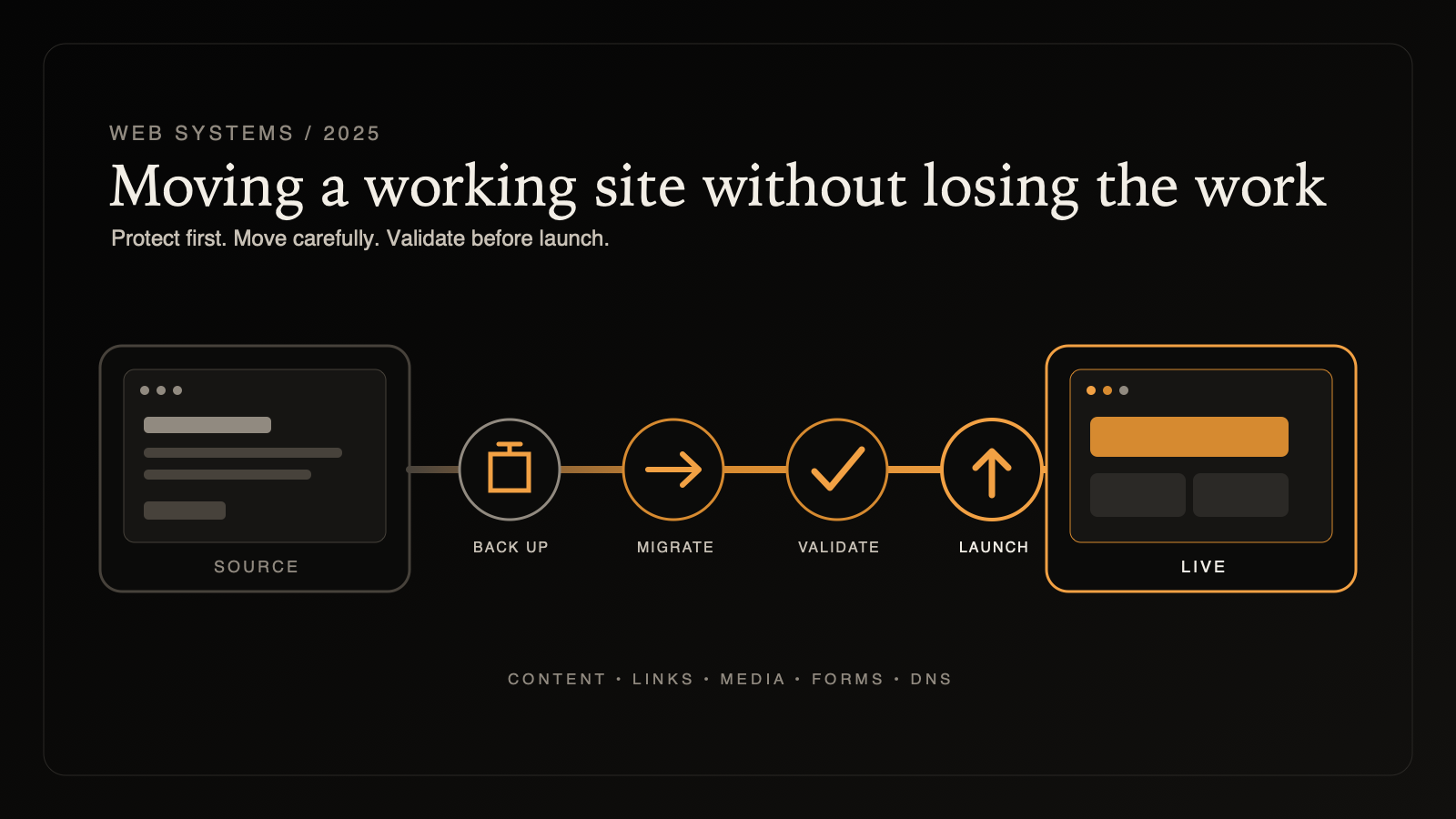
The migration was handled as a sequence rather than a single copy operation: preserve the starting state, move the site, update the supported environment, and then validate the result before cleanup.
Updating and testing the operating site
After the move, I updated the supported site components and worked through the validation steps recorded for the public and administrative sides of the environment.
I then completed a final smoke test before sign-off. The purpose was to check the migrated site as a working system rather than treating a successful homepage response as the only evidence.
Cleaning up without erasing the rollback path
Cleanup followed the migration and validation steps rather than preceding them. Material identified for removal was handled only after the pre-change backup existed, keeping the sequence recoverable.
The migration concluded with a fresh backup and final validation. Together with the pre-change recovery point, that documented both sides of the production change without making unsupported claims about the long-term storage or retirement of older systems.
The project reinforced that a production migration is not simply a file copy or a DNS change. A dependable migration connects preservation, environment changes, functional testing, careful cleanup, and a verified way to recover the state that was just approved.