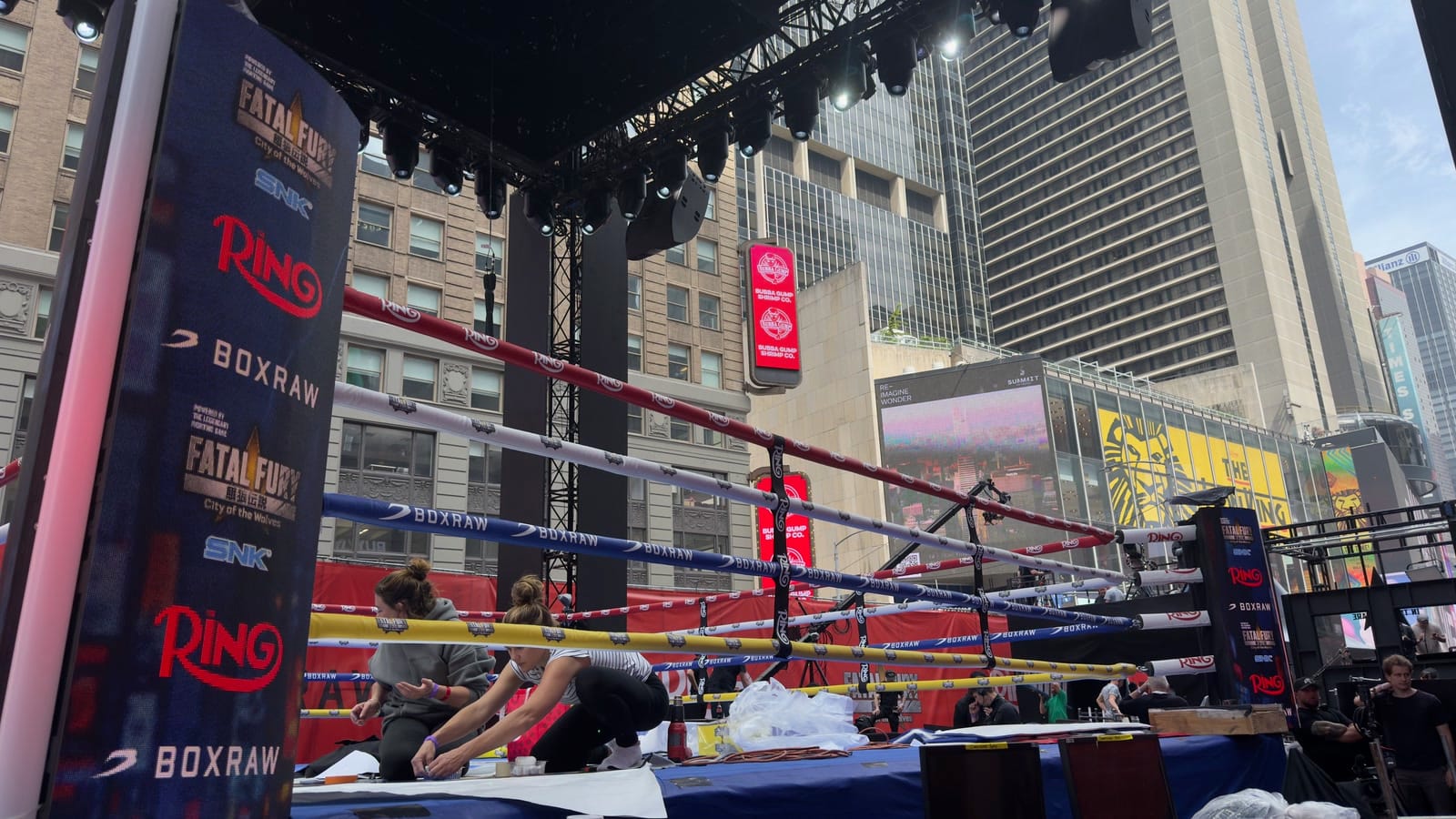
On May 2, 2025, The Ring presented Fatal Fury: City of the Wolves in Times Square, a boxing card headlined by Ryan Garcia and Rolando Romero. In the middle of one of the world's busiest public spaces, a temporary ring, lighting grid, camera positions, production areas, and transmission paths had to come together as one live venue.
My role was on the remote-integration, or REMI, transmission side. I deployed a LiveU server that let the remote production team receive and switch the feeds coming from Times Square. The technical story was how a temporary outdoor venue became part of a remote live-production system.
Building a broadcast venue in a public square
Times Square did not begin as a ready-made arena with permanent broadcast infrastructure. The production had to establish the ring, lighting, cameras, crew positions, power, communications, and network paths inside a public space that still had its own traffic, buildings, screens, and operating constraints.
The ring was the visible transformation. Behind it, the temporary transmission system had to make the venue usable for viewers who would never see the physical build. Every contribution feed needed a clear route from the event site into the remote production workflow.
Creating the REMI path out of Times Square
The LiveU server gave the remote team a place to receive and switch the incoming feeds without moving every production function into Times Square. I prepared that server as part of the REMI workflow and connected the field contribution paths to the remote operation.
Connectivity combined bonded cellular with an additional microwave internet path brought in by a satellite truck. The two approaches gave the temporary venue different ways to carry live video away from the site instead of depending on a single local connection.
Proving the temporary system before the live card
Setup on April 30 established the field and remote systems, and the May 1 rehearsal provided a full day to check the contribution feeds, server ingest, switching workflow, and connectivity before the live card. That rehearsal mattered because the venue and its broadcast infrastructure were both temporary.
On May 2, the same Times Square space functioned as both a boxing arena and the field side of a REMI production. The project showed that transforming a public plaza for a live event means building more than what the crowd can see: the remote switching, contribution paths, and internet connectivity are part of the venue too.