On November 5, 2025, I upgraded a production Wowza Streaming Engine server to a later supported build. The software update itself was only one part of the assignment. The larger responsibility was to make a controlled change to a system used for live media, preserve a way back, and verify that the services returned in the expected state.
Assessing the system before changing it
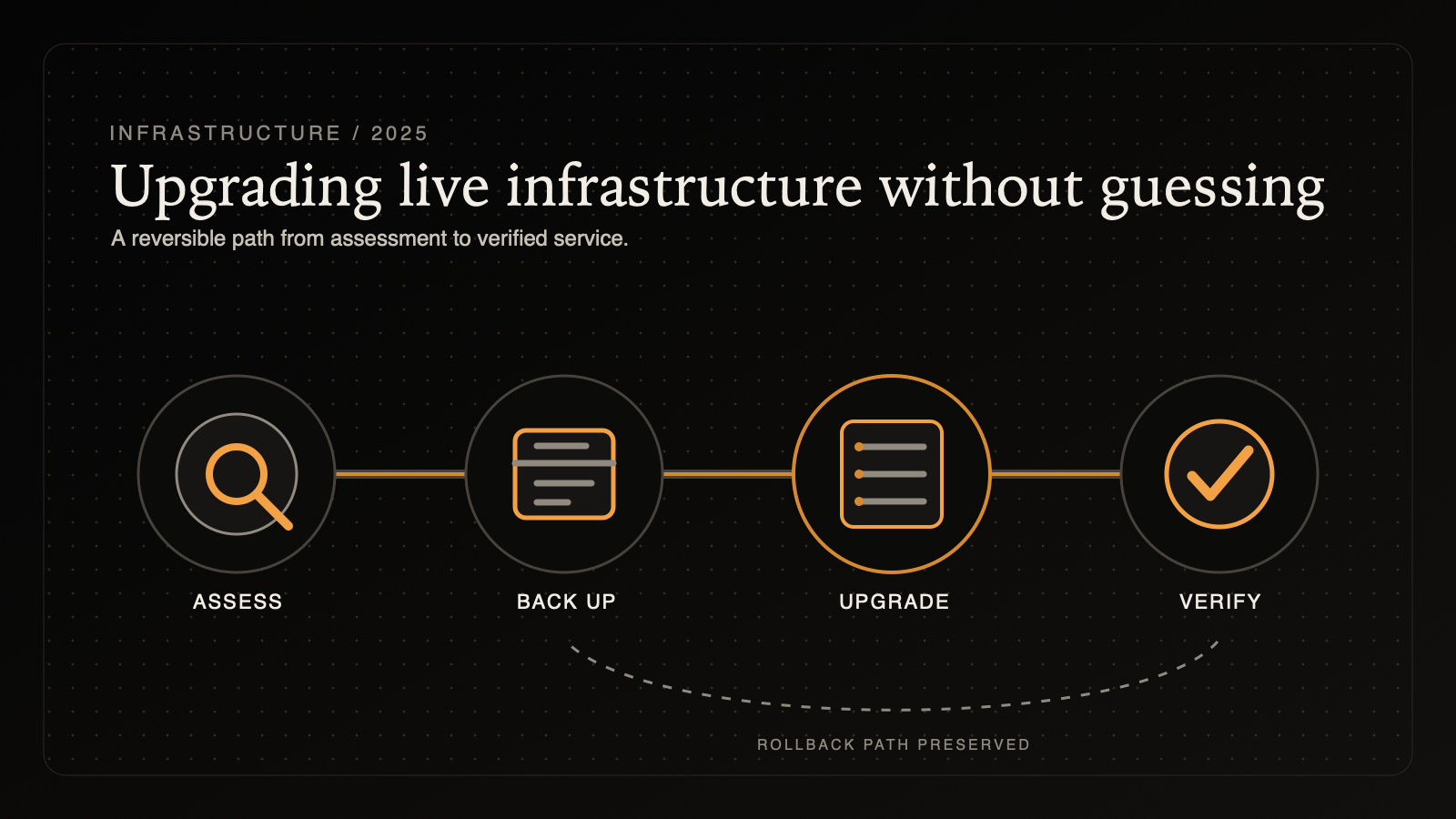
I began by confirming the installed Wowza version, reviewing the running services, and checking compatibility with the server's Java 21 environment. Those checks established the actual starting point and reduced the chance of discovering a prerequisite only after the streaming services had been stopped.
This article intentionally excludes the client, server identity, file paths, management address, application names, and stream configuration. They were relevant to the maintenance work but are not needed to explain the decision process publicly.
Creating a clean maintenance boundary
Before installing the update, I stopped both the streaming engine and its management service and verified that the related processes had ended cleanly. A clear stopped state matters because an upgrade should not be writing over a service that is still handling files or holding part of the previous runtime in memory.
The update process created an automatic backup of the earlier installation before applying the new package. That backup was the rollback point if verification failed. A maintenance plan is incomplete when it describes only the desired forward path; it also needs a specific recovery state and a decision about when to use it.
Verifying more than a successful installer
After the update completed, I restarted the streaming engine and management service. I then checked the service response and confirmed that Wowza reported the intended updated build. The point was not merely that an installation script reached its final line, but that the actual server process returned and identified itself as the expected version.
I also created a helper script for future maintenance. Repeating a known sequence through a small, readable tool can reduce skipped steps, but it does not replace judgment. Compatibility, backup state, maintenance timing, and post-restart validation still need to be reviewed for every change.
Maintenance as a recoverable operation
The engine and management services restarted on the updated build, and the service endpoint responded as expected. Those were service-level checks rather than an application-level playback test. The update process left an automatic backup as the documented rollback point.
This upgrade reinforced a principle that applies to live-streaming infrastructure and ordinary IT systems alike: the real unit of work is not the software update. It is the complete change window—known starting state, clean stop, recoverable backup, deliberate install, service restart, and evidence that the services recovered afterward.